The Leap: How 3 simple changes can propel your career from Good to Great
November 16, 2009 by Dr. Letitia Wright
Filed under Books, Featured Articles
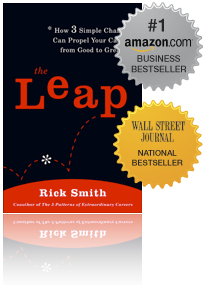
The Leap: How 3 simple changes can propel your career from Good to Great
Author: Rick Smith
This book starts with the author?s quest to understand how in 18 months he had gone from completely unremarkable to writing a best seller, founding a new company that he eventually sold for more money than he ever dreamed of. He wanted to find people who had achieved extraordinary success without the talents and drive that might have marked them as special from an early age. The book was meant to be a ?Good to Great? manual for individuals. I have read Good to Great, so…we?ll see.
Smith shares how in 2003, his co-written book, The 5 Patterns of Extraordinary Careers took off. The book was very successful and after 3 months of touring his company let him go. He felt like his career had crashed and burned. He was looking for a new job and going to networking meetings. After a while he realized the networking meetings had plenty of people but hardly ever did you see top ranking executives from any companies. He created his own and named it w50. This was almost instant success also. He wanted to learn how this had happened.

Smith has also added lots of stories of how other people did it. This can give you some good ideas and perhaps insight on what creates success. He has a create take on memes however, makes no point of what the reader should do with a meme. Should they get one, make up one, use one? I like the book; I am always interested in how other people go to their success.
This book is an L.A. 7
Crisis of Character: Building Corporate Reputation in the Age of Skepticism
November 9, 2009 by Dr. Letitia Wright
Filed under Books, Featured Articles

Book: Crisis of Character: Building Corporate Reputation in the Age of Skepticism
Author: Peter Firestein
We all know that one of the biggest problems the sales department has is getting your potential customers to believe that your products will do what you say they will do. They have to believe the services work as advertised to spend their money. This is the age of the informed consumer. As we begin to come out of the recession, people are cautious about how they spend their money. Even the wealthy are more careful about spending their money. The author puts corporations on notice that ?Reputation is the strongest determinant of any corporation?s sustainability. Stock prices can always come back. Business Strategies can always be changed. But then your reputation is gone, its retrieval is difficult, long-term and uncertain.?
After watching corporations, I think everyone wonders if they care about reputation, especially if the corporation is going under. At some point, no one at Enron cared about their reputation and negative impact on stake holders. The 7 Strategies of Reputation Leadership are a great list start from. The Case studies are interesting. The author outlines the steps to building corporate reputation. I wonder what the job title of the person who is responsible for this is.
The section on Reputation training covers ethics, internal communication and compliance. However the chapter on Tell Your Corporate Story disappoints as there is no information about media training. Getting on camera with no training can make your reputation worse because you do not come across to the public the way you want to. Most of the book is focused on internal dialogs among the employees of the company.
Dealing with the outside world is a big part of managing your reputation; however the author begins and ends with what is going on inside of the corporation itself with the goal of perfecting that. The book has lots of good case studies to plump it out.
This book is an L.A. 7
What?s Your MBA IQ? A Manager?s Career Development Tool
November 7, 2009 by Dr. Letitia Wright
Filed under Books, Featured Articles

This is a book review
Author: Devi Vallabhenenei
I love books, they way they feel and the way the look. I know that when you print a book, you kill more trees. But for me, there is just something about holding a physical book that I love. If you have read my other book reviews, you will note I always let you know when I a book is well made. This book is really a text book. Something I would expect a college professor to assign. I think in order to make the book lighter, these pages were made with very thin paper and which felt like phone book paper. The book was written to provide Business practitioners and those who want an MBA, a roadmap to facilitate advanced management education. Some of the chapters are listed below:
- General Management , Leadership and Strategy
- Marketing management
- Quality and Process Management
- Human resources management
- Accounting
- Finance
- Corporate Control, law , ethics and governance
- International business
- Project management

You can compute your IQ at their website with a self ?assessment. Then take the book and learn the areas you are weakest in. It is truly a text book. The Ethics chapter sites actual cases and laws. For example the authors explains the Sherman Act and the Clayton Act ( which strengthens the Sherman Act) and the Robinson-Patman Act ( which strengthens the Clayton Act). It would be great for self-study, however I am not sure what you would do if you have areas that you did not understand and needed help with. It could be great for a group study or a reference book for you if you are doing online classes for your MBA. You will be prepared to take the he Certified Business Manager (CBM) exam.
You have to be very motivated to get through this book.
This book is an L.A. 8