THE TRAVEL REVOLUTION
June 20, 2016 by Dr. Letitia Wright
Filed under Crowd Funding, Front Page
As a world traveler, I can see how helpful this would have been if I had it.
It’s funded at 81% of it’s goal, an easily identified winner. 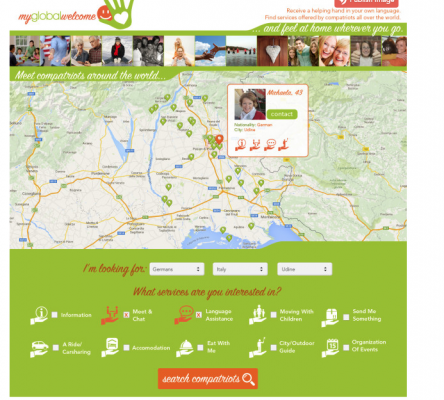
It is the WORLD’S FIRST SOCIAL NETWORK that eliminates the language problem before and while you’re moving in the world because it connects you with your fellow countrymen abroad who can help you with whatever problem you’ll have.
The New York Journal calls “My Global Welcome” the TRAVEL REVOLUTION.
Don’t miss out this once in a lifetime opportunity to make part of something truly great. If you like the idea of feeling at home wherever you go, then please help us create “My Global Welcome”. Here you’ll receive information on your fellow countrymen, where they are from, when and why they moved, their occupation, their hobbies and interests and what they like most about their new life. Only if you choose to contact them, will you be asked to log in at this point. Want to see other fellow countrymen first? No problem. They are shown underneath. After logging in, you will be able to contact your compatriots personally, and get assistance worldwide for whatever problem you might have.
The higher value rewards include our “Don’t Worry” and “High Five” membership for frequent and business travelers with even more services around the world and our unique, personalized, NUMBERED My Global Welcome Founder Membership Card. This edition is strictly limited and will show off your Founding Member status. Gain entry to future My Global Welcome meetups and events as our VIP guest and guest of honor. The first backer receives Card No. 1, and so on!
You can learn more about the perks and get started here
https://www.indiegogo.com/projects/the-travel-revolution–3#/
Meet the women who are #crowd-funding their way to riches
June 19, 2016 by Dr. Letitia Wright
Filed under Crowd Funding, Featured Articles

WHERE do start-ups, charities and artists turn when they need cash? They go to the place we all go for anything now: the internet.
Thanks to sites like ArtistShare, Pozible, Indiegogo and Kickstarter, crowd-funding has been the go-to investment platform for start-ups, and the pool of those requesting our spare cash is growing.
It’s estimated that crowd-funding raised more than $47 billion globally last year. If the trend continues, this year it will overtake venture capital as the largest source of start-up funding.
Scott Pape, the Barefoot Investor, has seen first-hand how “crooked” banks can be and believes “having new sources of funding is a good thing”.
So, why has the web become an alternative to getting a loan or hitting up your parents? “Because people are unable to get finance elsewhere,” says Mr Pape.
It’s also much easier to put out a call on social media than to spend years saving the old-fashioned way. Yet crowd-funding doesn’t make people entitled, insists finance expert Larissa Hamm, and instead “encourages us to think in a more entrepreneurial way”.
Let me share why this is significant: People would still like to have big weddings and many times are not in need of a bunch of gifts. They could get people to help with the wedding instead of asking for gifts or money. The people attending can actually see how their money was spent and feel more a part of the new couples life. After all, they helped get it started! It may seem crass now, however I predict that this will be the norm in a few years.
Want to know more about Crowdfunding? Get your Free report and get started now! Click the book below to Download it!
Start Here: 
Savvy students embrace crowdfunding for research
June 5, 2016 by Dr. Letitia Wright
Filed under Crowd Funding, Featured Articles

crowdfunding
Savvy students embrace crowdfunding for research
While research is a critical piece of academia, the pursuit of knowledge isn’t free.
A nationally shrinking pool of money for research projects has led several academics from Ohio universities to raise smaller amounts of capital through the nontraditional means of online crowdfunding.
University of Akron fellow Bor-Kai “Bill” Hsiung recently harnessed crowdfunding to help pay for his biology-related research project. Using Experiment.com — a site billed as a platform for enabling scientific discoveries — Hsiung entered a competition for research ventures based on unusual animal traits like a gecko’s sticky feet or the improbable punching power of the tiny pistol shrimp.
Hsiung’s work aims to mimic the nanostructures of tarantula hairs. Like his fellow Experiment.com competitors, the Taiwan native listed his proposal for friends, family and the general public to review and contribute to. The project raised $7,708 — putting Hsiung in third place overall — which garnered his research an additional $250.
Hsiung, who will use the funds to create 3D nano-printed models of spider hairs, said the long, arduous grant-proposal process motivated him to try a different form of fundraising.
“A grant to the NSF (National Science Foundation) takes three to six months to prepare, and you won’t hear the results for another six months,” Hsiung said. “Even if all goes smoothly, it can take a year or longer to get the money.”
As government grants can run into the six figures, asking for a relatively small amount via crowdfunding was the logical choice.
“It’s definitely hard work. You have to allocate time to market your research,” Hsiung said. “I learned how to communicate scientific ideas in a simple manner everyone could understand.”
Dr. Todd Blackledge, professor of biology and the Leuchtag Endowed Chair at University of Akron, said crowdfunding sites like Experiment.com are emerging in parallel to declining university research budgets. Federal support for all study and development, meanwhile, has fallen 16% over the past five years, according to the Association of American Medical Colleges.
“Accounts my students were counting on for grad research are being cut off,” Blackledge said. “There is no other way to fund these projects.”
The speed and flexibility of crowdfunding is particularly important for scientific research, insofar as events like the El Niño weather phenomenon have a shortened window where effects can be studied.
“The first couple days of the funding process are especially important,” Blackledge said. “There’s a chance to build positive momentum, but if you fall behind it’s hard to catch up.”
Miami University in Oxford, Ohio, launched a crowdfunding site called HawksNest in April. The platform allows faculty, students and staff to post a project for funding. An internal review team vets the proposal, which remains on site for a maximum of 45 days after approval.
James Oris, Miami’s associate provost for research and dean of its graduate school, pointed to crowdfunding’s ability to get small-scale requests off the ground. HawksNest organizers encourage cash-seekers to scale down the scope of projects if costs exceed $6,000.
“We’re also tapping into an alumni base that supports these projects at smaller values,” Oris said.
Crowdfunding for academic research has its drawbacks, some observers say. For example, the relative speed with which group-sourced money is raised negates the peer-review process that ensures dollars are being spent for their stated purpose.
However, HawksNest projects undergo a thorough review by program administrators, Oris said.
“Our main point is to find different ways to expand research and scholarship opportunities for our students,” he said.
Lauren Fussner, a graduate student in clinical psychology at Miami, is lead investigator on the first undertaking successfully funded through the school’s crowdfunding site. Fussner’s project, which identifies risk factors contributing to depression and eating disorders among adolescent females, raised $580 from 10 contributors, surpassing its original goal of $525.
It’s a modest amount, admittedly, but Fussner said she is thankful to receive funding to compensate participants involved in the study. In seeking donations, Fussner and her partners posted pertinent information to their social media accounts. The project leader also used contacts from her University of Notre Dame undergraduate alumni group to further market the effort.
“I was genuinely excited to share my project, which I believe helped others understand the importance of the work,” Fussner said.
Frustration with the unpredictable, politically motivated nature of science and academic research funding led Cindy Wu to co-create Experiment.com — one of a growing number of websites dedicated to advancing the findings of researchers. Introduced in 2012, the site has backed projects in economics, physics, biology and medicine.
Like Kickstarter, Indiegogo and other crowdfunding sources, newspapers — delivered FREE to your inbox every morning. Sign up for the Morning Newsletter.
Let me share why this is significant: As Americans sort out how they want to pay for education, crowdfunding is a clear option. Students will have to take the forefront. Most universities have a crowdfunding page or site, however, students do not have to rely on that. They can take matters into their own hands and move their projects forward.
You can read the rest of the Article Here
Want to know more about Crowdfunding? Get your Free report and get started now! Click the book below to Download it!
Start Here: